Batch Release by Exception: What a Pharma MES Should Block Before QA Signs
Published 22 October 2026 · 7 minute read
A typical paper or hybrid batch record runs to dozens of pages. When the batch is finished, QA reads every one of them: each weight, each time, each initial, each attached printout. Most of those lines are normal. QA reads them anyway, because nothing on the page says which ones are not. Release waits until the last page is checked.
Review by exception turns that around. The system checks every line against what was planned, and QA reviews the exceptions: the things that were outside a limit, still open or missing. Done properly, it is not a lighter review. It is a review where the machine does the arithmetic and the comparisons, and the person spends their time on judgement.
This article sets out what an electronic batch record (EBR) system should check before QA can sign, and how the release step should behave. It is written for QA, production and automation engineers working under 21 CFR Part 211, EU GMP and similar regimes.
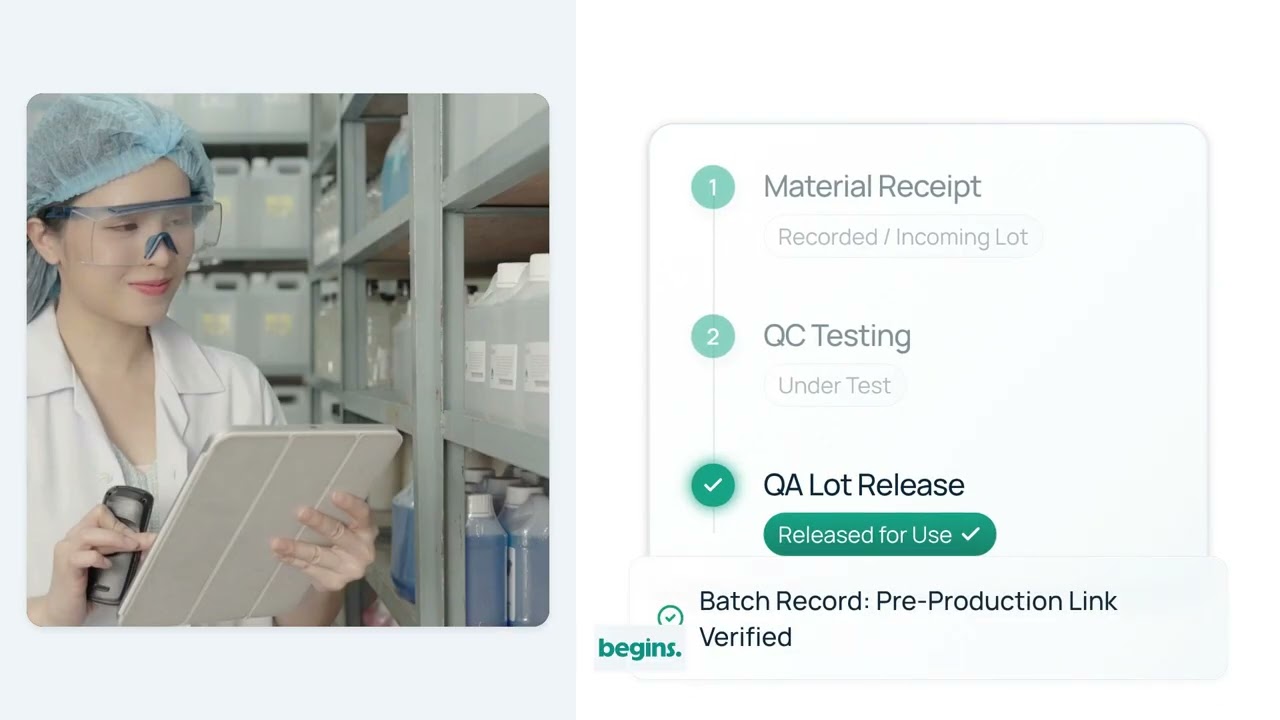
Two-minute walkthrough: from material receipt to QA release. Shown against India's Revised Schedule M; the same controls support FDA 21 CFR Part 11 and EU GMP Annex 11. Watch on YouTube
What review by exception means, and what it does not
Review by exception rests on three conditions. If any one is missing, it becomes review by assumption.
- The numbers come from the source. A dose actual should be the value the controller recorded, not a value typed from a screen. If the record can contain transcription errors, every line still needs a human check.
- The limits are defined in the recipe. "Outside tolerance" only means something if the approved recipe declares the target and the tolerance for each material and each critical parameter.
- The checks are enforced, not advisory. A warning that can be clicked away is not an exception process. The release itself must be refused while an exception is open.
Review by exception does not mean QA never looks at the full record. It means the full record is available and complete, and the exceptions are put in front of the reviewer first, with nothing hidden.
What a pharma MES should block before QA signs
These are the conditions under which an ACCEPT (release) disposition should be refused. Each one is a question an inspector would ask about a released batch.
- A material reconciled outside recipe tolerance. If the recipe says 2.5 kg ±5 % and the record shows 2.3 kg, the batch cannot be released until that is explained. See the 0.2 kg your batch record never saw for a case where the record, not the dose, was wrong.
- An open deviation linked to the batch. A deviation is not closed until it has been investigated and QA has signed the closure. Release before closure means releasing on a guess about the outcome.
- An open quality hold. A hold exists precisely to stop disposition.
- A required quality result that is missing or failing. Assay, moisture, hardness or whatever the specification requires. Missing is not the same as passing.
- An unresolved material exception. For example a substitution, a short reservation or a lot problem raised during the batch and not yet dispositioned.
- Zero output, or yield below the minimum. A batch that produced nothing, or far less than expected, has a story that needs telling before anyone signs.
- A PLC counter discrepancy without a closed deviation. When the controller's count and the recorded count disagree, a deviation explains why, and it must be closed.
List every reason at once
A release screen that shows the first problem it finds is a slow way to learn about the second. QA fixes the tolerance question, tries again, and only then discovers the open hold. Every round trip delays release and invites the feeling that the system is in the way.
The gate should evaluate every condition every time, and list all of them together in plain words: which material, which deviation number, which result. The check should also run again at the moment of signing, not only when the screen was opened, so that nothing that changed in between slips through.
Reject and scrap are never blocked
The gate exists to stop a bad batch going out. It should never stop a bad batch being rejected. If QA decides to reject or scrap, the decision is signed with its meaning and a reason, and it is allowed whatever is still open. A system that blocks rejection until the paperwork is tidy creates pressure to leave a nonconforming batch in limbo.
One final disposition, and signed amendments
Each batch should have one final disposition. If something changes later, such as a late result or a corrected consumption, the change should not overwrite the disposition or edit the record silently. It should be a new, signed amendment record that states what changed, why, and which earlier version it supersedes. That way the record shows the history an inspector expects to see: what was known at release, and what was learned afterwards. The mechanics of linking a signature to the exact record are covered in 21 CFR Part 11 §11.70: linking an electronic signature to the whole batch record.
Where Annex 16 and the Qualified Person fit
In the EU and in PIC/S member regimes, EU GMP Annex 16 describes certification of a batch by a Qualified Person before release. The QP must be satisfied that the batch was made and checked in line with its marketing authorisation and GMP, and that deviations have been assessed. A release gate does not replace that judgement. What it does is make sure the QP never certifies a batch while a known exception is still open, and that the record they review is complete. In the US, the same logic applies to the quality unit's release under 21 CFR 211.192 (production record review) and 211.22.
What the gate depends on upstream
A release gate is only as good as the record behind it. Three upstream controls make the gate trustworthy:
- Released material only. Lots are QC-tested and released by QA before use, and reserved in first-expired, first-out order when the batch is created.
- A released line clearance tied to the batch number. See GMP line clearance and equipment status.
- Quantities recorded from the controller, under an ISA-88 recipe where the PLC is master. See ISA standards and batch tracking and traceability.
How PulseMQ does it
In PulseMQ, the QA disposition screen refuses ACCEPT while any of the seven conditions above holds, and lists every reason at once. Reject and scrap are never blocked. Each batch has one final disposition, and later changes go through a signed amendment record. The release signature requires password re-entry, records its meaning, and binds a fingerprint of the full batch record as shown at signing. Deviations close only with a QA signature from someone other than their creator. A person in a production role cannot release.
PulseMQ is built to support GMP release and your validation of it. It does not make a plant compliant; that remains the manufacturer's responsibility for its validated system. See the pharmaceutical and GMP overview for the full flow.
Pilot it on one batch line. We connect to your PLC, map its phases and dose actuals to the record, and your own QA signs real dispositions on your own batches.
See the pharma pilotFrequently asked
What is review by exception in batch record review?
The system checks every line of the batch record against the approved recipe and its limits, and QA reviews the exceptions: values outside tolerance, open deviations or holds, missing results. It depends on numbers recorded from the source, limits defined in the recipe and checks that are enforced rather than advisory.
What should block a batch from being released?
A material reconciled outside recipe tolerance, an open deviation linked to the batch, an open quality hold, a required quality result missing or failing, an unresolved material exception, zero output or yield below the minimum, and a PLC counter discrepancy without a closed deviation.
Should a release gate block rejection?
No. The gate exists to stop a bad batch being released, not to stop it being rejected. Reject and scrap should always be allowed, signed with a meaning and a reason.
Does review by exception replace the Qualified Person?
No. Under EU GMP Annex 16 the QP certifies the batch. A release gate makes sure the QP never certifies while a known exception is open, and that the record they review is complete.