The PLC runs the batch. The record writes itself.
QA releases only what is clean.
PulseMQ executes ISA-88 batches with the PLC as master, records the quantities the controller actually dosed, ties line clearance and equipment status to the batch number, and refuses QA release while any exception is open. Every signing act is an electronic signature with its meaning recorded.
See it in two minutes
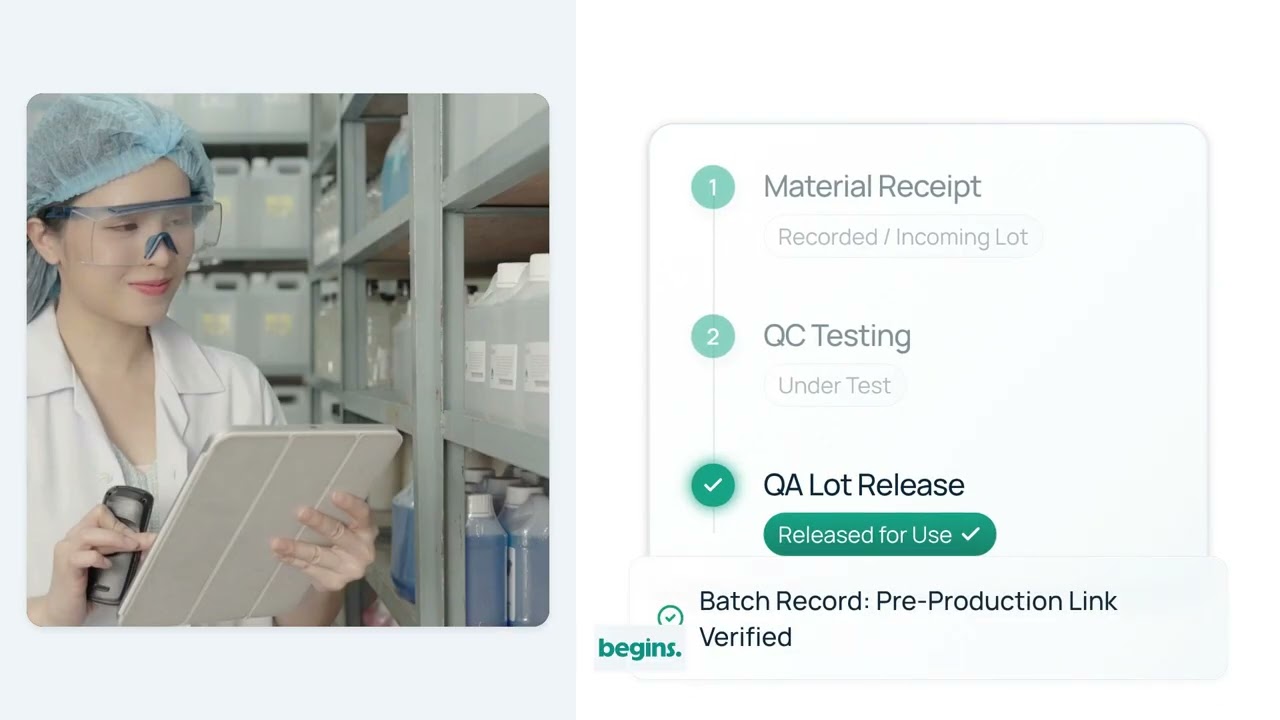
Two-minute walkthrough: from material receipt to QA release. Shown against India's Revised Schedule M; the same controls support FDA 21 CFR Part 11 and EU GMP Annex 11. Watch on YouTube
The problem: a batch record that is reviewed line by line
Many GMP plants still run on paper batch records, or on a hybrid: a printed record with values copied from an HMI screen, a weigh-room printout stapled to page six, and a spreadsheet for yield. QA then reviews every line of every batch, because nothing in the record tells them which lines are normal and which are not. Release waits on that review.
Hybrid records are also where data integrity breaks down. A value transcribed by hand is not the original. A dose read off a screen ten minutes later is not contemporaneous. A correction made with a pen and initials does not say which version it replaced. Inspectors who apply ALCOA+ (attributable, legible, contemporaneous, original, accurate, plus complete, consistent, enduring and available) look for exactly these gaps.
An electronic batch record (EBR) fixes this only if the numbers come from the controller, the system enforces the checks the procedure describes, and QA can review by exception: everything normal is shown as normal, and every exception is listed and must be closed before release.
What PulseMQ is, and is not. PulseMQ is built to support GMP batch manufacturing and the electronic records and signature requirements of 21 CFR Part 11 and EU GMP Annex 11. It is not "compliant", "validated" or "certified" on its own, and no software is: compliance belongs to the regulated company and its validated computerised system. PulseMQ provides the controls and a validation document set to support your validation.
Written for global GMP regimes
The same controls serve plants inspected under different authorities. The regulations PulseMQ is designed around include:
- FDA 21 CFR Part 11: electronic records and electronic signatures, including signature manifestation and signature/record linking (§11.50, §11.70).
- EU GMP Annex 11: computerised systems, audit trails, data integrity and electronic signatures.
- EU GMP Annex 16: certification by a Qualified Person and batch release.
- PIC/S GMP and WHO GMP, including their guidance on data integrity.
- National regimes built on the same principles, such as India's Revised Schedule M.
- ISPE GAMP 5: the risk-based approach to computerised-system validation our validation documents follow.
- ISA-88: the batch control model behind recipes, phases and the PLC-to-MES contract. See ISA standards.
From an approved recipe to a released batch
- Approved recipe Part 11A recipe moves from draft to review to QA approval, and the approval is signed. Withdrawing an approved recipe is its own QA-signed act with the meaning WITHDRAWN and a reason, and it is refused while open batches still use the recipe.
- Released material, reserved in FEFO orderMaterial lots are QC-tested and released by a QA signature, and the person who received a lot cannot release it. When a batch is created, its materials are reserved in strict first-expired, first-out order. Lots past their retest date are excluded and shown greyed out. On a regulated site, a batch whose material cannot be reserved is refused, with the material that is short and by how much. A shortage override exists, but it is requested with a reason and signed by a second person from QA.
- Equipment status and line clearanceEach piece of equipment carries its qualification (with a validity date), cleaning status and maintenance. A line clearance is performed by an operator and verified and released by a different QA user, and it is tied to one batch number. A clearance for a number already used by a batch is refused, and on a regulated site a batch cannot be created or dispatched without a released clearance for its number. More in GMP line clearance and equipment status.
- ISA-88 execution, with the PLC as master ISA-88PulseMQ downloads the control recipe and the PLC acknowledges the download by echoing its sequence number. The PLC runs the phases. Where a phase requires a confirmation, the operator or supervisor signs it with their password, and the PLC accepts or rejects that confirmation. PulseMQ cannot end a batch until the PLC is idle or aborted, and the closeout is acknowledged by the PLC.
- Quantities from the controllerDose actuals per phase, the final quantity and defects at completion are recorded from the PLC. PulseMQ records the controller's numbers; it does not calculate them. Why this matters is in the 0.2 kg your batch record never saw.
- Deviations, CAPA and calibrationA deviation moves from open to investigation to submitted, and QA closes it with a signature. The person who created it cannot close it. An out-of-tolerance calibration approved by QA automatically opens a draft deviation, with the impact window back to the last passing calibration.
- QA release by exception Annex 16QA sees the exceptions, not every line. ACCEPT is refused while any exception is open, and every reason is listed at once. There is one final disposition per batch. See the gate below.
- Signed, linked and tamper-evident §11.70The release signature binds a fingerprint (hash) of the full batch record as it was shown at signing, including scan evidence. After release the evidence is locked. Any correction is a new signed record that names the fingerprint of the version it supersedes. More in linking a signature to the whole batch record.
- Audit trailDeviations, holds, equipment and clearance records and reconciliation are written to append-only, hash-chained records, and a tamper check verifies the chain.
- Maintenance and safety formsPreventive maintenance and safety form templates are published, and reviews accepted, with electronic signatures on regulated sites.
The QA release gate: review by exception
When QA opens a batch for disposition, the server checks every condition below. If any one holds, ACCEPT is refused and all the reasons are listed together, so nobody fixes one, retries, and discovers the next.
ACCEPT is refused while:
- a material was reconciled outside the recipe tolerance;
- a deviation linked to the batch is still open;
- a quality hold is open;
- a required quality result is missing or failing;
- a material exception is unresolved;
- output is zero, or yield is below the minimum;
- a PLC counter discrepancy exists without a closed deviation.
Reject and scrap are never blocked. Each batch gets one final disposition; a later change goes through a signed amendment record, not an edit. Read more in batch release by exception.
Electronic signatures and data integrity
These are technical controls. How they fit your procedures and your validated system is decided in your own validation.
| Expectation | What it asks for | How PulseMQ supports it |
|---|---|---|
| Signature | The signer is identified at the moment of signing, and the signature shows its meaning. | Password re-entry for every signing act. Name, role, time and meaning (RELEASED, REJECTED, APPROVED, WITHDRAWN, VERIFIED) are recorded. |
| Linking | A signature cannot be removed, copied or transferred to falsify a record. | The release signature binds a hash of the full batch record shown at signing. Corrections are signed records naming the hash they supersede. |
| Duties | The person who does the work does not approve it. | A production role cannot release. A QA approver is never the author. A receiver cannot release their own lot. A clearance is verified by a different user. |
| Audit trail | Changes are recorded with who, when and what, and cannot be altered. | Append-only, hash-chained records with a tamper check over the chain. |
| Original data | Values come from the source, not a transcription. | Dose actuals and final counts are recorded from the PLC. Signed corrections to consumption carry a reason and a source of truth, such as the PLC record. |
How validation works with PulseMQ
You validate your computerised system; we give you what you need to do it efficiently. PulseMQ comes with a validation document set designed to support a GAMP 5 risk-based approach:
Validation plan, URS and FRS
A validation plan template, user and functional requirements, and a GxP risk assessment that decides where testing effort goes.
Requirements traced to tests
A traceability matrix from each requirement to the tests that cover it.
IQ, OQ and PQ protocols
Protocol templates for installation, operational and performance qualification. Automated test evidence (thousands of unit and integration tests) is mapped to the OQ cases.
Logs and the validation report
A test execution log, a deviation log for test failures, and a validation report template.
Your QA owns the decisions: the intended use, the risk ratings, which tests run on your line, and whether the system is fit for GMP use. PQ runs on your own process with your own people signing.
How it connects
- An edge gateway beside the line reads Allen-Bradley and other PLCs and publishes over MQTT with Sparkplug B. No new controllers are needed; the ISA-88 handshake is implemented in the PLC program.
- Where it runs. In the cloud on AWS, or on-premise. The edge gateway can run on an air-gapped plant network.
- Your line, your limits. Phases, materials, tolerances and which confirmations need a signature are set up for your process during the pilot.
More on the gateway on the deployment page and the platform overview. Watch the recipe to batch demo.
Pilot it on one batch line
- One line. Pick the line where batch record review holds up release the most.
- We connect to your PLC and map its phases, dose actuals and counts to the record.
- Your QA signs real dispositions on your own batches, and judges whether the record stands up to your inspectors.
- Validation documents from day one, so the pilot feeds your own validation rather than being thrown away.
Talk to us about a pilot
Tell us what you make, your batch size and phases, and the PLCs on the line. Choose Engineering Pilot on the contact form.
Further reading
Batch release by exception
What a pharma MES should block before QA signs.21 CFR Part 11 §11.70
Linking an electronic signature to the whole batch record.The 0.2 kg your batch record never saw
Edge deadband and dose accuracy.GMP line clearance and equipment status
Tying clearance to the batch number.Batch tracking and traceability
Lot genealogy in any batch plant.ISA-88, ISA-95 and ISA-106
The standards behind recipes and phases.Frequently asked
Is PulseMQ 21 CFR Part 11 or GMP compliant?
No software is compliant on its own. Compliance belongs to the regulated company and its validated system. PulseMQ provides technical controls designed for Part 11 and Annex 11, such as signatures with password re-entry and a recorded meaning, segregation of duties and a hash-chained audit trail, and a validation document set that supports your own computerised-system validation.
Does the MES control the batch, or the PLC?
The PLC. PulseMQ downloads the control recipe, the PLC acknowledges it and runs the phases, and the PLC accepts or rejects each operator confirmation. PulseMQ cannot end a batch until the PLC is idle or aborted, and the closeout is acknowledged by the PLC.
Can QA override a blocked release?
No. While any exception is open, ACCEPT is refused and every reason is listed at once. Each exception is closed through its own recorded route, such as a deviation closed by QA. Reject and scrap are never blocked.
Can PulseMQ run on-premise?
PulseMQ runs in the cloud on AWS or on-premise, and the edge gateway that reads the PLC can run on an air-gapped plant network. The deployment model is agreed when the pilot is scoped.